January 30, 2026 at 10:17 p.m.
Getting creative
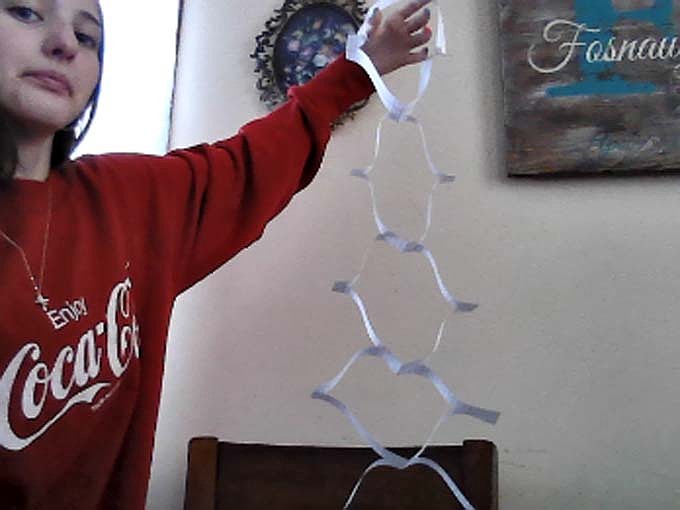
With in-person classes canceled for four consecutive school days, teachers got creative with some of their lessons this week.
Meg Mauger gave students a hands-on engineering challenge Tuesday while Chris Krieg invited them to dream about getting away from snowy landscapes and sub-zero wind chills.
Jay School Corporation called off classes Jan. 23 because of frigid temperatures and the first three days of this week because of nearly a foot of snow from the winter storm that followed. (Students and teachers returned to their classrooms on a two-hour delay Thursday.)
While not the ideal situation, Krieg noted that he has plenty of ideas after months of remote teaching in 2020 during the height of the COVID-19 pandemic.
He brought one of those projects back in his Digital Design class this week, asking students to create their own travel brochures.
“Being printing and designing, it’s tough to do virtually, so you’ve kind of got to get creative,” Krieg said, adding that students don’t have access to all of the computer programs that they would at school so they use Google Slides instead.
Mauger, who teaches engineering classes at the junior-senior high, also made the most of items anyone would have on hand at home. She gave her students an engineering challenge — take a regular 8.5-by-11-inch sheet of paper and cut a hole in it in such a way that they could fit their bodies through it.
“I try to continue to work on the standards and the skills that we're trying to promote, which is problem-solving, learning the design process,” said Mauger. “And so we try to make it fun and let them get a little time off screen.”
Once students in Krieg’s class selected their dream vacation locations — they included Cape Cod, Massachusetts, Rio de Janeiro and Greece — he asked them to research those locales. They were to find 10 to 12 places to stay, places to eat and things to do.
“I've always wanted to go to Greece,” said Lincoln Clamme of his chosen destination. “I just think their architecture is awesome. I’ve just always seen some pretty amazing pictures. It’s just always been kind of a cool place.”
Students were then asked to expand on what they had found by detailing hotel amenities, menu items and attraction details. For instance, Brooklyn Arnold shared information about Hotel Vila Galé Rio de Janeiro’s outdoor pool and full-service spa.
Using Google Slides, they created a travel brochure.
Krieg’s plan was to complete the projects upon returning to in-person classes and have students present their vacation destinations to their classmates.
“It's pretty good,” said Clamme. “I mean, it's not too hard but it does make you have to like look around and find different things. That's pretty fun.”
The paper-cutting project for Mauger’s class is about problem-solving. She wants to see what kind of creative solutions students will come up with, as well as gauging their thought process as one idea might fail and they try another.
“That's why they're given two pieces of paper,” she said, “because you can fail and you want the next solution to be better. And it's all about improvement rather than about finding the right answer. And it's about trying things. And so even if you don't come up with a solution that works, the fact that you worked towards a solution is what gets you credit.”
One student tried cutting a cross in the middle of the paper and sticking their head through. Another bent the rules and connected multiple pieces of paper together.
Mauger said about 60% of her 26 students across two classes found at least a “semi-workable” solution.
One of those was eighth grader Allianna Fosnaugh.
She explained her process, which involved folding a sheet of paper in half and then cutting thin strips perpendicular to the fold but without going all the way through in opposite directions.
“And then I opened the piece of paper up and cut all of the middle except for the two ends,” Fosnaugh said. “And then it was a big circle and then I could fit through it.”
She said she had seen similar challenges in the past, so she tried to duplicate the results on her own.
It worked.
“I thought it was really fun,” said Fosnaugh. “It’s a different project that’s not normal. You actually have to figure out how to do it.”
That’s the idea, to keep projects light but still keep students learning, even if they’re away from the classroom.
“My engineering classes kind of open themselves up for a more creative remote learning,” said Mauger. “And lots of what we do at school, they can't do on their Chromebooks. So it gives me an opportunity to give them something different and out of the box to do.”
Top Stories
9/11 NEVER FORGET Mobile Exhibit
Chartwells marketing
September 17, 2024 7:36 a.m.